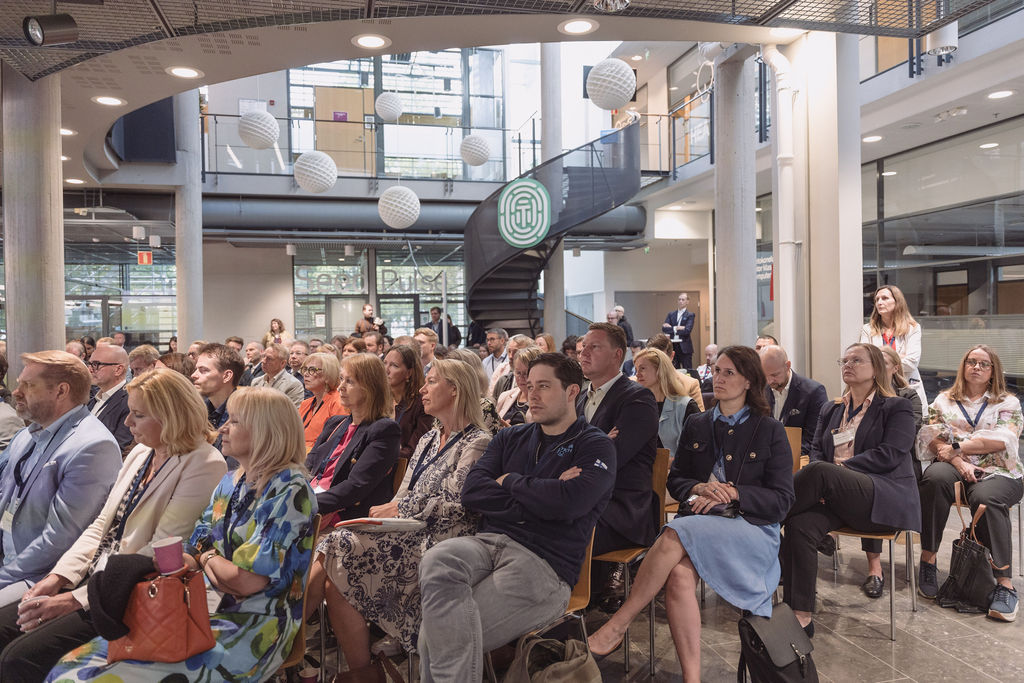
Health innovation is created via deep collaboration. As a delegation from Health Capital Helsinki set out to visit the local health ecosystems in Toronto and Minnesota in May 2022, the delegation had a clear goal in mind: to learn as much a possible on the road and to find out, what kind of potential for joint ventures exist between the top health players in North America and Finland.
Minnesota and Toronto ecosystems are open to collaboration and have great track records in nurturing innovation in ecosystems.
Toronto area rooted in scientific excellence
In Toronto, the delegation visited for example the University Health Network, JLABS Toronto and Centre for Commercialization of Regenerative Medicine (CCRM). Michael H. May, President & CEO of CCRM, believes that collaborating across disciplines and geographies is essential in order to realize the promise of advanced medicines.“The initial contact between prospective partners may not appear to reap obvious benefits, but when the timing is right and the champions are in place, these initial meetings can trigger meaningful collaboration,” May says.Talking about the Toronto/Ontario ecosystem, May notes that the area is rooted in scientific excellence, with great universities and exceptional clinic infrastructure.“There’s also a concentration of expertise, infrastructure and activities in places like Toronto’s Discovery District where collaboration and synergy are inevitable,” he says, adding that proximity to the US, the largest and most entrepreneurial market in the world, is also a big plus.Michael H. May, President & CEO, Centre for Commercialization of Regenerative Medicine (CCRM)
With suitable engagement, collaboration would thrive between Canada and Finland across healthcare and other industries.
Sharing the same mindset
Commenting on the potential for collaboration between Finland and Ontario, May says that the two markets are small, but they have similar healthcare systems, entrepreneurial resources, and strong scientific foundations – as well as access to bigger markets.“They both have similar social and political systems. I believe that with suitable engagement, collaboration would thrive between Canada and Finland across healthcare and other industries.”Health Capital Helsinki delegation from left: Heidi Humala (City of Helsinki), Santtu von Bruun (University of Helsinki), Seppo Laukkanen (Lantern), Teemu Moilanen (Haaga-Helia University of Applied Sciences), Minna Elomaa-Krapu (Metropolia University of Applied Sciences), Juha Paakkola (Health Capital Helsinki) and Päivi Haho (Metropolia University of Applied Sciences).
Mayo Clinic leading Minnesota’s world-class health sector
Next up for the delegation: visit to Minnesota, the US, which was, in fact, reciprocal in nature – Tim Walz, the Governor of Minnesota, just visited Helsinki last year.“Furthermore, the health sector is extremely strong in the state, with Mayo Clinic often ranked as the best hospital in the world. In addition, the local health sector companies are frequently world-leading in their own areas,” says Juha Paakkola.Laurence Reszetar, Director, International Business Strategy, from Minnesota Trade Office says that the visit of the Health Capital Helsinki delegation deepened the ties between the two health ecosystems.“These visits are exceptionally valuable as we can identify solutions to common health challenges and opportunities for collaboration, particularly in areas of diagnostics and digital health – and keeping the data secure from outside threats.”
Minnesotan can-do-attitude
Reszetar feels that the “secret sauce” behind the successful Minnesota health ecosystem is, ultimately, the people. Minnesotans are doers, he says.“We build things in our labs and garages and we love solving problems. Plus, we have a virtuous cycle of management, where Minnesotans gain skills and experience in one company and bring that talent to another company to help it grow.”In addition to Mayo Clinic, the Finnish delegation visited in Minnesota e.g. Destination Medical Center, Medtronic headquarters and Finnish American Chamber of Commerce.
Minnesotan health sector is extremely strong, with Mayo Clinic often ranked as the best hospital in the world.
Doors open for Finnish companies
Reszetar believes that Minnesota is a great place for US market entry because of the people, the companies and great accessibility. Minnesota’s workforce spans the spectrum of the medical ecosystem, from the engineers to the clinicians to the regulatory and reimbursement specialists and to the manufacturing staff and marketers, he says.“No place in the US has the mix we have and that’s also because our companies similarly span the ecosystem – from innovators to manufacturers to world leading hospital systems.”What’s more, the locals really like working with each other, too. This creates a business scene where newcomers and fresh ideas are welcomed and celebrated, even.“It’s possible to have a morning coffee with a CEO of a startup company, a lunch with a leading doctor, an afternoon meeting with an experienced marketer, and a dinner with a representative from an insurance company,” Reszetar gives an example.Laurence Reszetar, Director, International Business Strategy, from Minnesota Trade Office
Great prospects for cooperation
Juha Paakkola says that in both Minnesota and Toronto, the Helsinki delegation felt very welcome: after Covid-19 pandemic, it was great to have these types of “meetings of the minds” once again.“Also, Minnesota and Toronto ecosystems have rather unique profiles, so it was worthwhile that we got acquainted with both.”Furthermore, the two regions may yet be “under the radar” for many, as the best-known North American ecosystems are located on the coast (e.g. Silicon Valley or Boston area).“I felt that while Minnesota and Toronto are perhaps less known, they certainly are open to collaboration and have great track records in nurturing innovation in ecosystems. There’s no limit to what we can achieve together,” says Paakkola.“Based on our successful meetings, many collaboration discussions are ongoing and we expect also follow-up meetings later,” he adds.Text: Sami J. Anteroinen
Health Capital Helsinki